Newsletter & Free Trial Signup

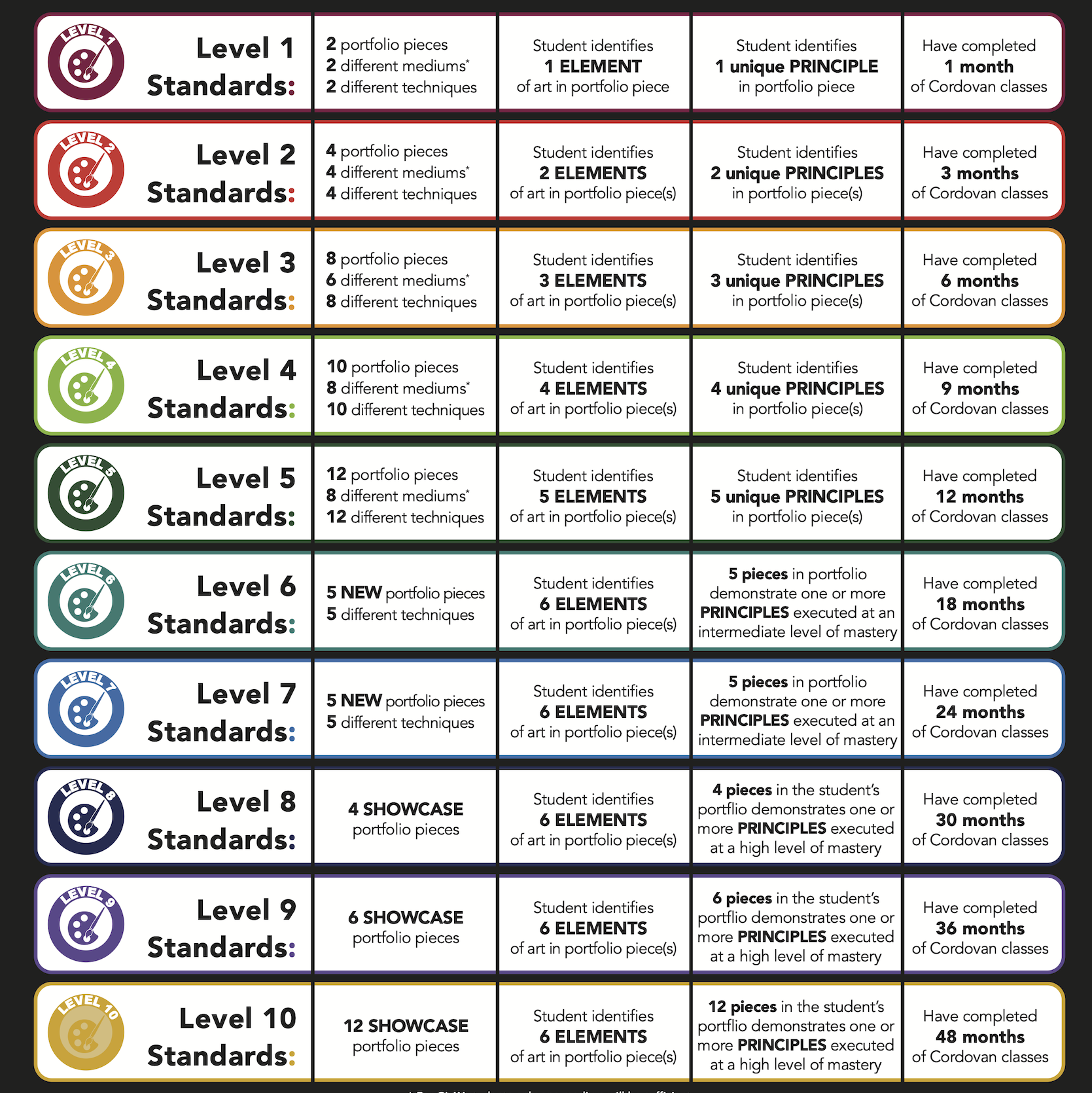
It’s time for Cordovan Students to LEVEL UP in art!


Here’s how it works

Step 1: All students receive an Apron and Cordovan logo pin

  • Students will receive their very own Cordovan apron and Cordovan logo pin when they arrive to class the week of October 6-11. Students should bring their aprons with them to class each week to protect their clothing.

Step 2: Students attend classes to build their portfolio

  • Teachers teach lesson plans based on the PRINCIPLES and ELEMENTS of art and design.
  • Students build their portfolios over time: Students choose their favorite pieces to place into their portfolio. As their skills improve, students can replace old portfolio pieces with newer pieces.

Step 3: Students present their portfolios to the class

  • Students bring their artwork to the portfolio review in order to advance. Reviews are held once per month during the last 10-15 minutes of class. Portfolio reviews take place during the week following first Monday of each month.
  • If a students forgets what to say when sharing their artwork, the teacher will gently help them! The teacher is there to help, give positive encouragement, and guid the student in their personal growth as an artist. No negative feedback is allowed during portfolio reviews.

Step 4: Students advancements

  • All students that meet the qualifications will PASS their portfolio review and advance to the next level where they will continue to build upon their portfolio.
  • Parents are invited to attend the portfolio reviews.

Watch this video to see what a Student Portfolio Review (Pin Ceremony) looks like.

Special thanks to the students and teachers at NW Austin Studio!


7 Principles of Art & Design

  • BALANCE
  • CONTRAST
  • EMPHASIS
  • MOVEMENT/ RHYTHM
  • PATTERN/ REPETITION
  • UNITY/ HARMONY/ VARIETY
  • PROPORTION/ SCALE

The PRINCIPLES answer the question “WHY”.

For example:

Why Does CONTRAST matter? Contrast matters because it’s how our eyes and brains tell things apart. Without contrast, everything blends together.

WHY does PROPORTION/ SCALE matter? The reason why proportion/ scale matters is that if I draw a tree smaller than I draw the bird sitting in that tree, the drawing will feel wrong–because everyone knows that a tree is larger than a bird.


6 Elements of Art & Design

  • LINE
  • SHAPE/ FORM (shape is 2-D/ form is 3-D)
  • SPACE
  • VALUE
  • COLOR
  • TEXTURE

The ELEMENTS answer the question “WHAT”.

These are the basic building blocks of art and design–the core components that make up the piece of art. Most works of art contain all of the elements.

For example:

WHAT will I use to create stronger patterns in my artwork? I will use TEXTURE!

WHAT will I use to create stronger contrast? I will use VALUE!

WHAT will I use to create more emphasis? I will use COLOR and SPACE!


Techniques used in Art & Design

  • Dry Brush
  • Wet-on-wet
  • Slip & Score
  • Slab
  • Pressure
  • Thick to Thin Lines
  • Stippling
  • Collage
  • Contouring
  • Blotting
  • Glazing
  • Crosshatching
  • The list of techniques is never-ending

The TECHNIQUES answer the question “HOW”.

For example:

HOW do I create more texture in my painting? I will use a DRY BRUSH technique.

HOW can I merge two (2) clay pieces together? I will use a SLIP & SCORE technique.

HOW can I create a thicker line? I will apply more PRESSURE. Or I will use MULTIPLE LINES.


Frequently Asked Questions

When the new Achievement Program launches in October 2025, students may “test out” of Levels 1–5 if they meet all the requirements for those levels. After October 2025, students will not be allowed to skip levels. The only exception is for returning students who previously took a break; they may be placed back into the appropriate level based on their prior progress.

Even though some students may already have the skills to advance beyond level 5, the highest level a student may test out of is level 5. This policy ensures that all students build a strong foundation in the Cordovan Art School teaching methodology.

To test out of a level, students must also meet the following minimum time requirements as a Cordovan Art School student:

  • Level 1: 1 month minimum
  • Level 2: 3 months minimum
  • Level 3: 6 months minimum
  • Level 4: 9 months minimum
  • Level 5: 12 months minimum

Time permitting, students may share more than one artwork from their portfolio with the class during their presentation. If there is not enough time to review every requirement in class, the teacher may review the remainder of the portfolio privately to ensure all requirements are met. Repetition is valuable. As students hear the PRINCIPLES, ELEMENTS, and TECHNIQUES explained during portfolio reviews, the repeated exposure helps reinforce these concepts and strengthens learning for the entire class.

Yes. Students may demonstrate the same Principle again. However, Level 2 requires two Principles, so the student would need to choose one additional Principle besides “Balance” in order to advance to Level 2.

Yes, but only for for levels 1-5. The process of building a portfolio is cumulative.

Levels 1–5 (Beginning): Students may reuse the same pieces, adding new work along the way. However, during their class presentations, it is recommended that they choose unique piece(s) to show the class that they have not presented before, so it isn’t a repeat presentation.

Levels 6–7 (Intermediate): Students must start over with brand-new portfolio pieces that demonstrate higher quality work.

Levels 8–10 (Advanced): Students may use ANY of their artwork, as long as the pieces are showcase-worthy. In most cases, artwork created for Levels 1–7 will not carry over into Level 8-10.

No. We do not require students to frame their artwork for the portfolio review. If a piece is already framed, that is acceptable, but framing should never be an expectation or requirement.

Since our curriculum is built upon the PRINCIPLES and ELEMENTS of art, the learning applies to all forms of art, including clay classes. The TECHNIQUES, however, will vary from medium to medium.

No. A student enrolled in a Drawing & Sketching class may successfully pass a portfolio review using only the medium of graphite. However, students are encouraged to explore a range of drawing mediums to broaden their experience and strengthen their skills. Common mediums in Drawing & Sketching include: Graphite, Charcoal (vine, compressed sticks, pencils, etc), Pastels, Markers, Oil Pastels, Colored Pencils, Pen & Ink, Brush Pens, Silverpoint, Scratchboard, Digital Drawing.

No. A student enrolled in a Drawing & Sketching class may successfully pass a portfolio review using only the medium of graphite. However, students are encouraged to explore a range of drawing mediums to broaden their experience and strengthen their skills. Common mediums in Drawing & Sketching include: Graphite, Charcoal (vine, compressed sticks, pencils, etc), Pastels, Markers, Oil Pastels, Colored Pencils, Pen & Ink, Brush Pens, Silverpoint, Scratchboard, Digital Drawing.

This curriculum is designed to recognize students for their effort and personal growth. When a student brings the required number of portfolio pieces and can use the correct art vocabulary to describe their work (with teacher support if needed), they will advance to the next level–provided they have also met the minimum time requirements as a Cordovan student. The most challenging part of a portfolio review is the work that’s already been done creating the artwork! Becoming a talented artist takes time, practice, and dedication. Portfolio reviews are meant to be a celebration of all those months of effort, growth, and learning.

It is important to remember that no two students are alike. Each artist progresses at their own pace. Think of it like a running analogy: every runner is striving for their own “personal best”. Just as no two runners run the same race, no two artists create or progress in the same way. Our goal is to recognize each artist for their unique journey and individual growth.

For levels 8, 9, and 10, students are expected to demonstrate a higher level of craftsmanship and skill in their portfolio reviews. Advancement at these upper levels requires not only effort and vocabulary, but also a stronger artistic ability, attention to detail, and technical refinement. Levels 8 and 9 are to designed to help the student work their way up to level 10.

The highest award–LEVEL 10–will require a more rigorous and structured portfolio submission process. At this stage, students should present work that reflects maturity, consistency, and mastery of techniques, as well as the ability to thoughtfully evaluate and articulate their artistic choices. Talk with your teacher when you are ready for 8, 9, and 10, and they will help you get ready!

If a student does not feel comfortable presenting in front of the class, they should let their teacher or the studio manager know ahead of time. Teachers can provide an alternate option such as a 1:1 review. The goal is to work with each student individually so they can receive recognition in a comfortable setting where the students feels supported and confident.

Students may include artwork created both inside and outside of Cordovan Art School in their portfolios, as long as the pieces demonstrate the required Principles, Elements, and Techniques for their level. For example, many students may want to work on their pieces at home, and this should be encouraged.

A brand-new student becomes eligible to receive their Level 1 pin after completing their first full month of enrollment. For example, if a student enrolls on September 15, their first full month of classes is October. This means they would eligible to receive their level 1 pin during the November portfolio review.

Aprons and Level Pins are shared across all classes. A student only receives one apron and progresses through one set of Level Pins, regardless of how many classes they are enrolled in. When it is time for a student to participate in their portfolio review, they can choose to present in either class…or they can choose to present to both classes!

Yes, students should take their aprons home each week. Since we do not have storage space at the studio, we cannot hold aprons or be responsible if they are lost or stolen.

If an apron or pins are lost or stolen, students have the option to buy replacements.

A student’s progress does not reset. All time and goals they’ve already achieved remain recorded, so the student can continue where they left off when they return.